
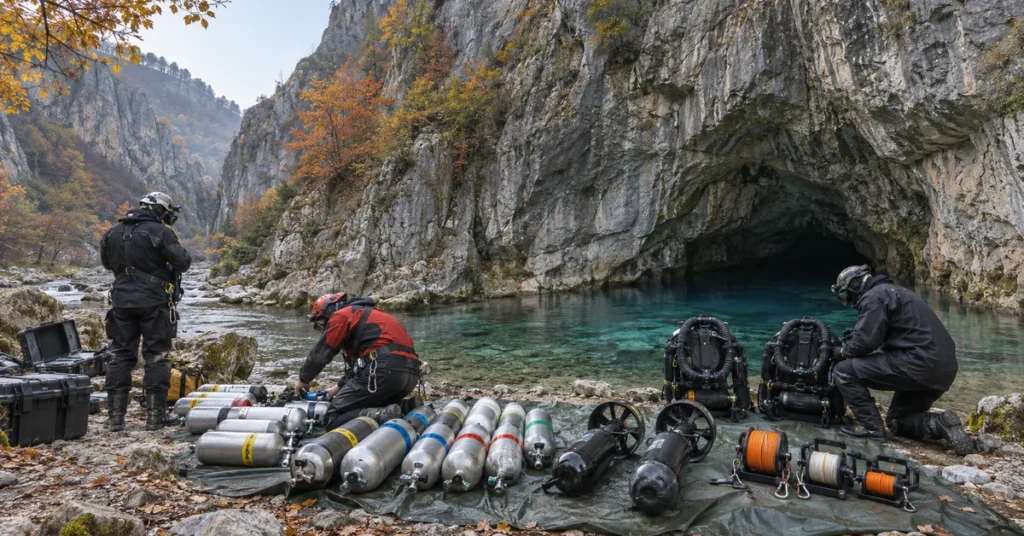
At Matka Vrelo, Polish diver Bartłomiej Pitala reached 338 meters, exceeding the previous cave-diving depth record in a team expedition. 1 The reported depth had not been officially ratified by Guinness World Records when the report was published. Behind the number lay months of preparation, backup breathing systems, and support divers positioned for a long return to the surface. 1
On this page
How Support Divers Prepared the Matka Vrelo Expedition
Poland’s BAD Exploration Team and the local diving organization Club Vrelo conducted the expedition in North Macedonia after months of preparation.1 Before the main attempt, Pitala completed four preliminary dives to depths of 150, 190, 240 and 290 meters to refine the decompression schedule, emergency procedures and equipment distribution.1
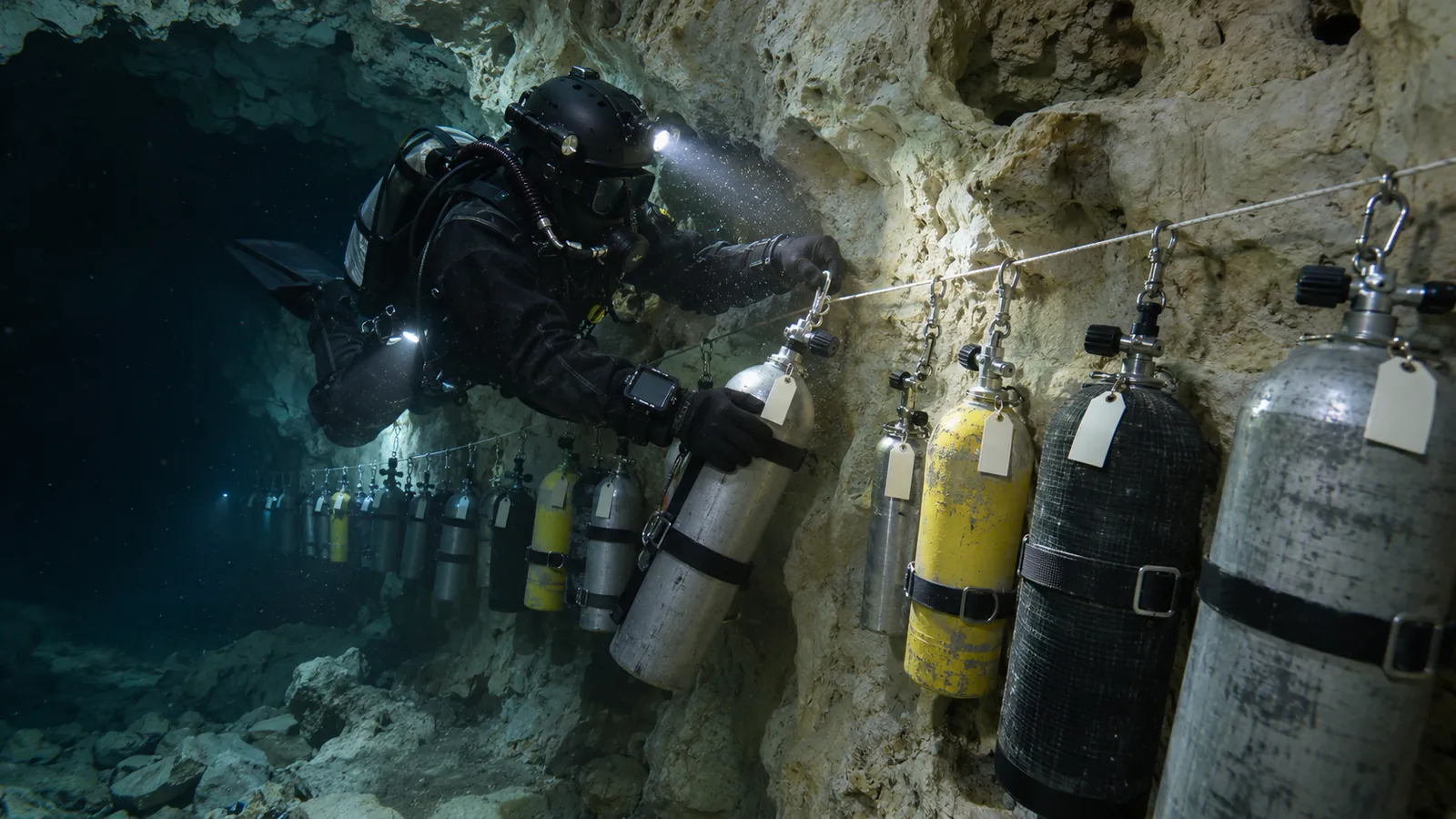
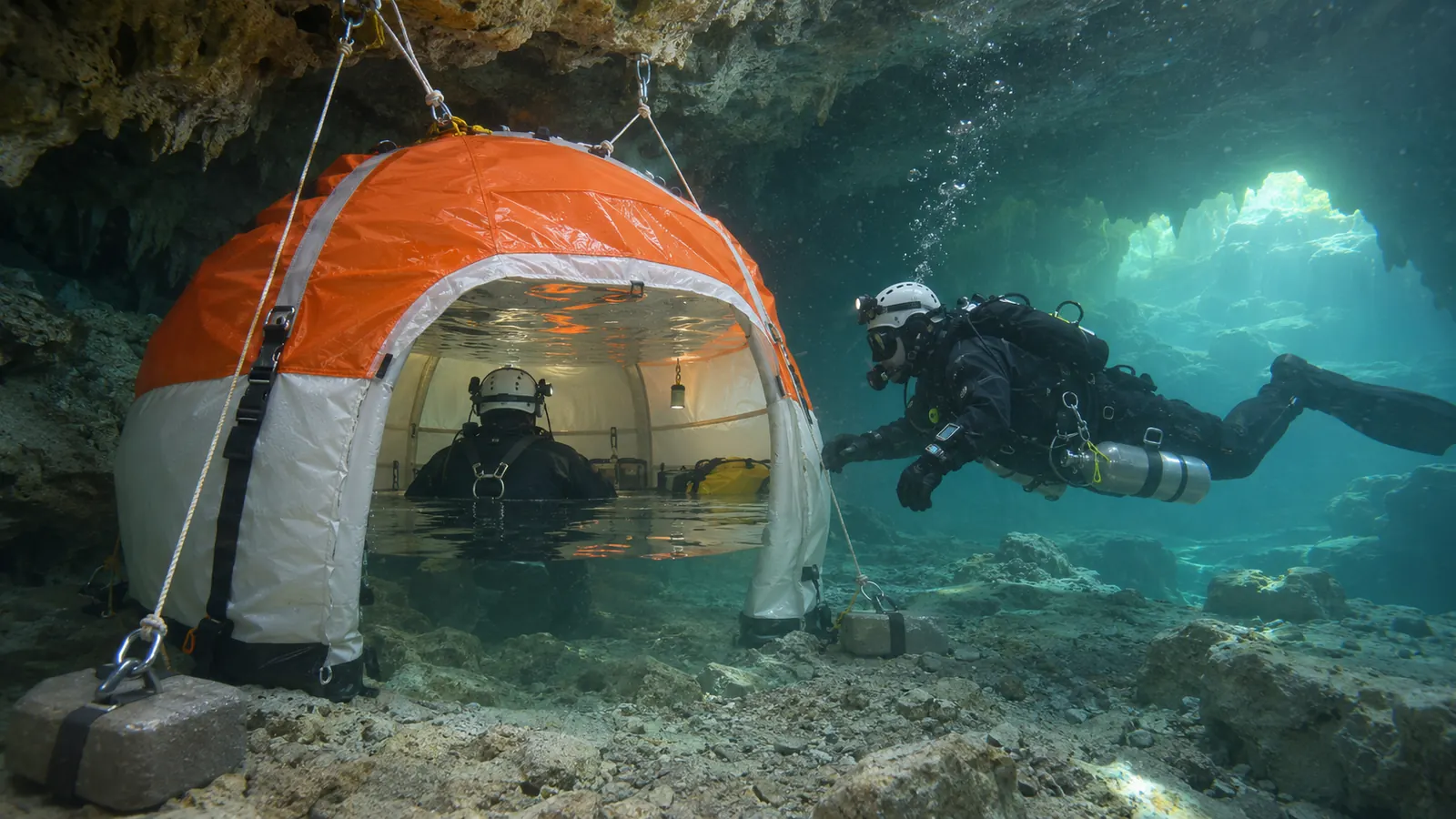
More than 25 emergency breathing-gas cylinders were positioned inside the cave down to a depth of 180 meters, while support divers were stationed along the ascent route.1 The team also prepared an air-filled underwater habitat at eight meters, intended to let Pitala complete part of his decompression in a warm environment if his drysuit failed or another problem arose during the ascent.1
The Reported Depth and the Route into the Cave
Pitala’s dive computer recorded 338 meters in Matka Vrelo, 26 meters beyond the previous cave-diving record.1 Another account of the expedition credits the team with exploring approximately 150 meters of new cave passage, including two previously unknown channels.2
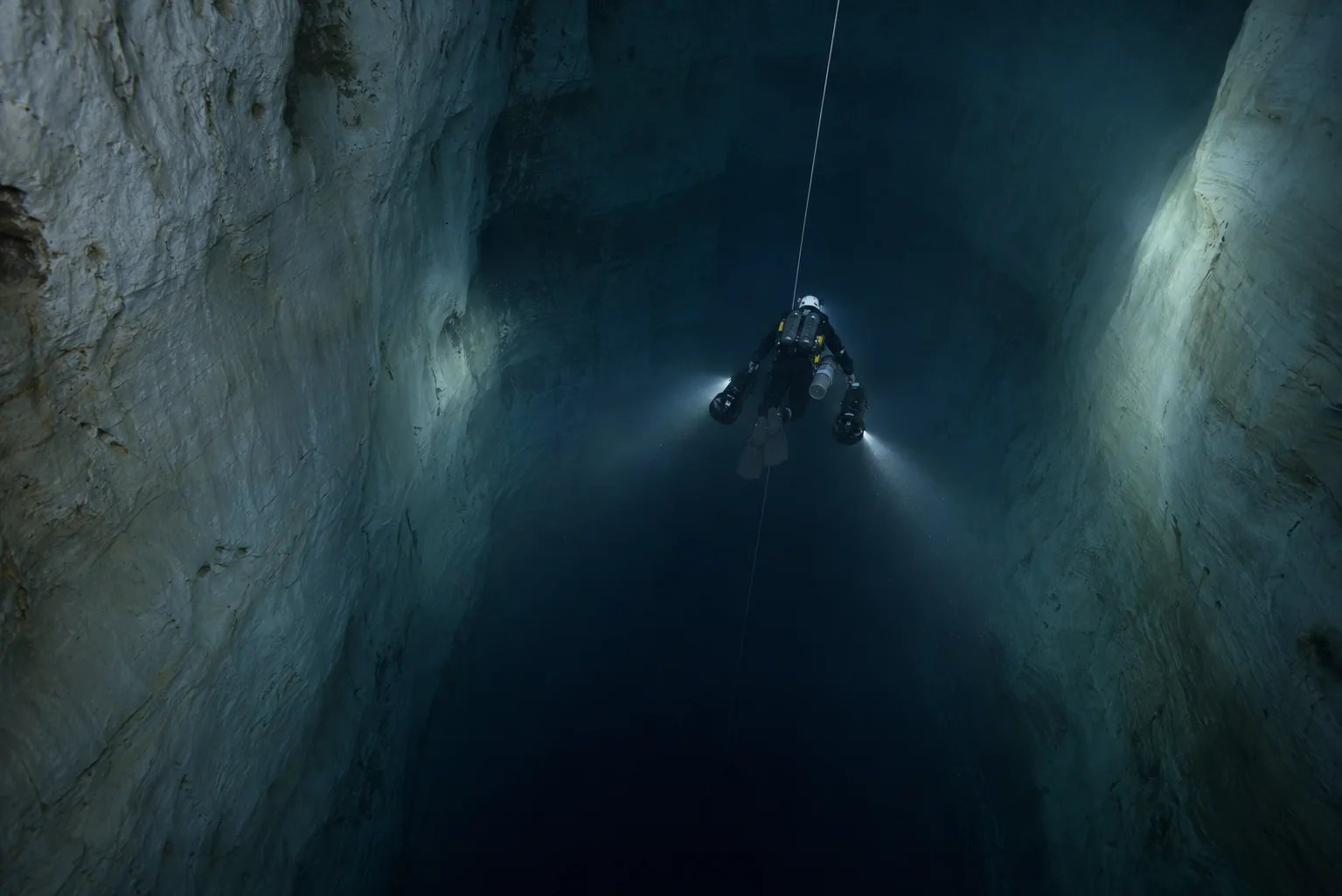
The dive began shortly after 10 a.m. on 16 October, with support divers accompanying Pitala to a point 350 meters inside the cave and 24 meters deep.1 From there, he continued alone through the main shaft using two diver propulsion vehicles.1 His primary breathing system was a back-mounted Liberty closed-circuit rebreather, backed up by a sidemount Liberty system and another bailout unit delivered to him at 140 meters.1
How 338 Meters Compared with Earlier Dives
French diver Xavier Méniscus had set the previous cave-diving benchmark at approximately 312 meters in Font Estramar in 2024.3 Pitala’s reported depth of 338 meters exceeds that result by about 26 meters, but the reported depth and formal verification were separate matters at publication.3
The dive also went 51 meters beyond Pitala’s own previous depth in Matka Vrelo: 287 meters during a 2025 expedition.1 The team’s objective was to extend exploration beyond the 300-meter mark, and Pitala wrote that they had not expected such a deep result before the dive.1
What Pitala Reported About HPNS
The preliminary dives were intended partly to test Pitala’s possible response to high-pressure nervous syndrome, or HPNS, which can occur while breathing a helium-containing gas under high pressure.1 According to the source, its symptoms can include tremors, dizziness and impaired coordination.1
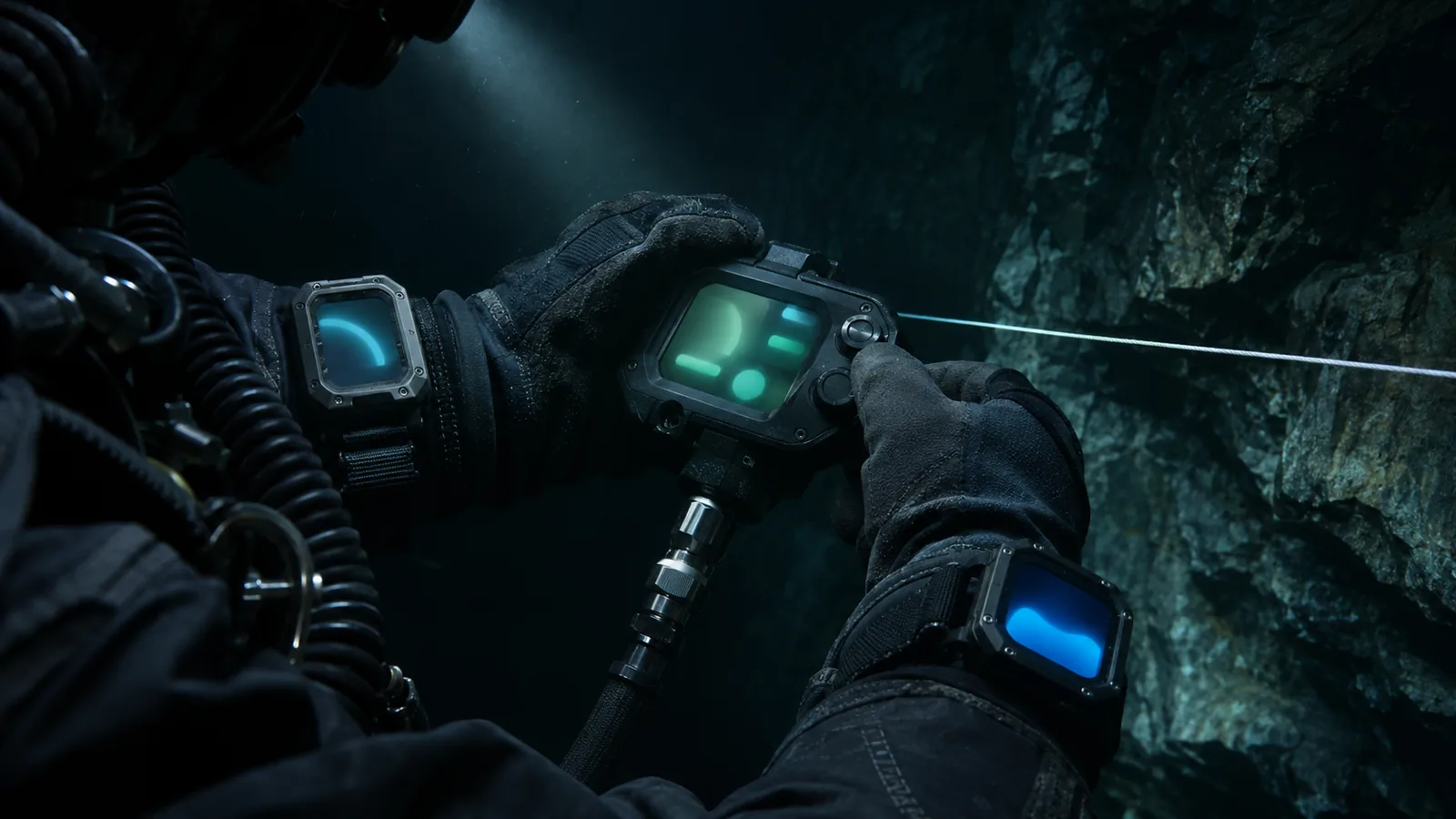
Pitala reported no visual impairment or other HPNS symptoms in the deepest part of the dive, and said gas density did not cause him problems.1 In another interview, he described simultaneously monitoring the passage, his instruments, the propulsion vehicles and his own condition.3 These observations describe Pitala’s experience on that dive. They do not establish that such depths are free of risk.1
Why He Turned Back Before the Cave Ended
Pitala did not reach the cave floor or the end of the passage, which was still descending when he turned around.3 He explained that he stopped at 338 meters because he did not want to test the equipment’s limits any further, particularly the strain placed on the propulsion vehicles.3
Before the dive, the team had calculated an exploration window of up to 45 seconds in the new section to keep the total dive time within its planned limit.1 Pitala said he still had roughly twenty seconds available at maximum depth but chose to return.1 The achievement marks the deepest point reached by a person in the cave. The final depth of the Matka Vrelo system remained unknown.3
Support Divers and More Than Eight Hours of Decompression
The return to the surface involved more than eight hours of decompression, accompanied by support divers.1 Pitala slowed his ascent from 210 meters and said this decision added approximately an hour and a half to his planned decompression obligation.1 He reported no decompression problems in the water or after surfacing and ultimately did not need to use the prepared underwater habitat.1
The operation also included medical and rescue personnel, a hyperbaric chamber on standby and a helicopter made available to the expedition.2 The support structure, preliminary dives, and redundant systems were parts of a dedicated exploration project. Recreational divers should not treat this account as operating instructions.1 For the broader distinction in planning, equipment, and ascent obligations, read our comparison of technical and recreational diving. The reported achievement at Matka Vrelo remained distinct from an officially ratified record when the story was published.1