
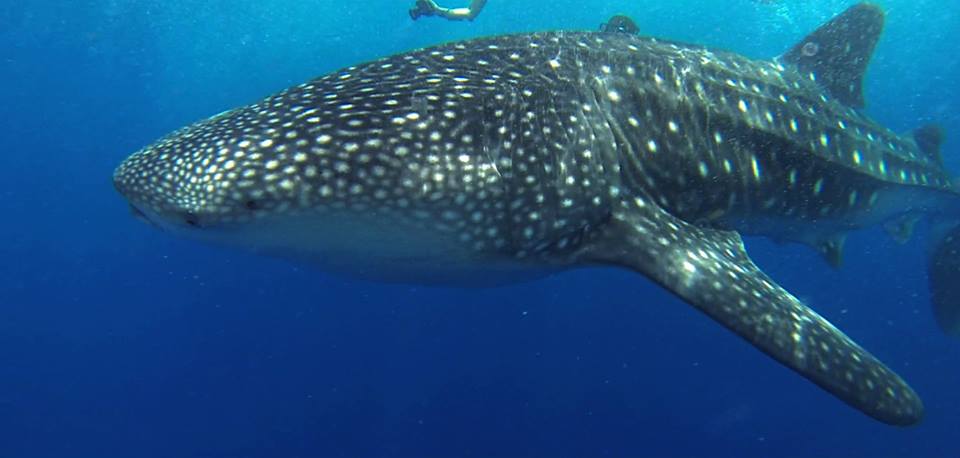
Whale sharks filter tiny prey through an enormous mouth, and their markings let researchers recognize individual fish. Here is a closer look at how they feed, where they travel, what is known about their lives, and how to give them space during an encounter. Their scale is impressive, but the smaller details tell much of the story.
On this page
How whale sharks feed
The whale shark, Rhincodon typus, is the largest fish known today. Despite its enormous size and wide mouth, it is a filter feeder. Its diet consists mainly of plankton, including microscopic animals and plants, along with tiny shrimp and small fish.
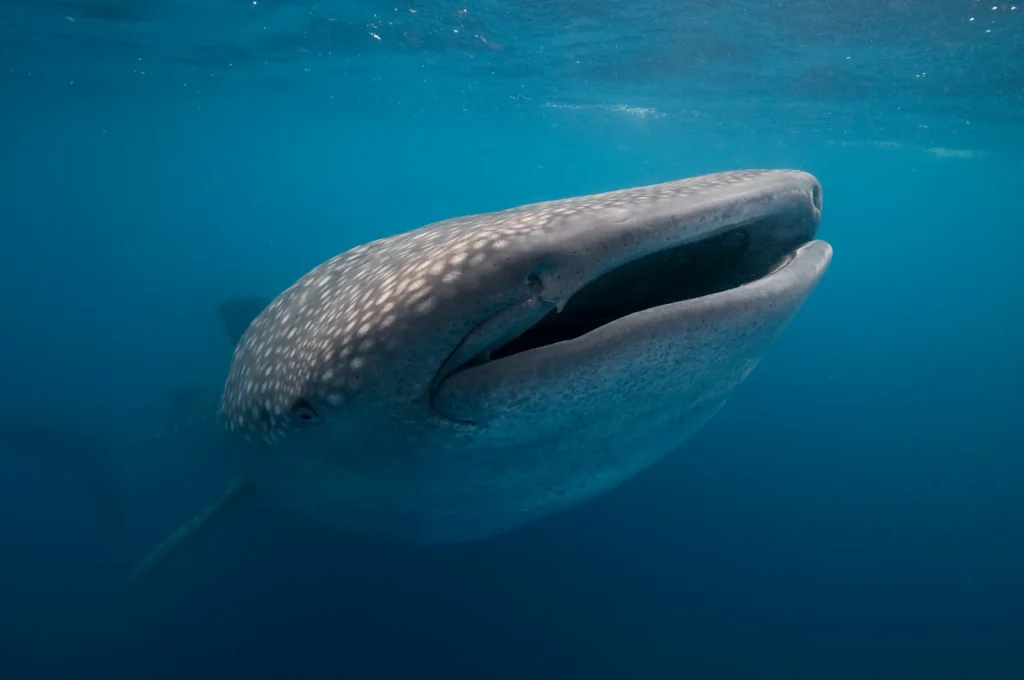
A mouth that can reach about 1.5 meters across makes room for this feeding system. Filtering pads sit inside, alongside hundreds of rows of tiny teeth. Five large gill slits on each side let filtered water flow out. Small eyes sit on either side of the broad, flat head.
The teeth are a striking detail in an animal that feeds this way. To understand its meals, look at the filtering pads and water passing through the gills. The size of the mouth tells only part of the feeding story.
Where they find food
Whale sharks live in warm and temperate waters, mainly around the equator. They migrate with the seasons in search of food, and some visit the Red Sea in spring. Their movements make feeding areas especially important places to study them.
In 2009, researchers counted up to 420 whale sharks during a single aerial survey off Mexico’s Yucatan Peninsula. The animals were feeding on little tunny eggs. Some feeding sites attract them seasonally and support wildlife tourism, but a known gathering place does not guarantee a sighting on your visit.
Spots, skin, and a flexible skeleton
The mostly gray body has a white belly, with pale yellow spots and stripes across the back. Each shark has its own pattern. Those differences help researchers identify individuals and count populations: a useful reminder to look beyond the animal’s overall size.
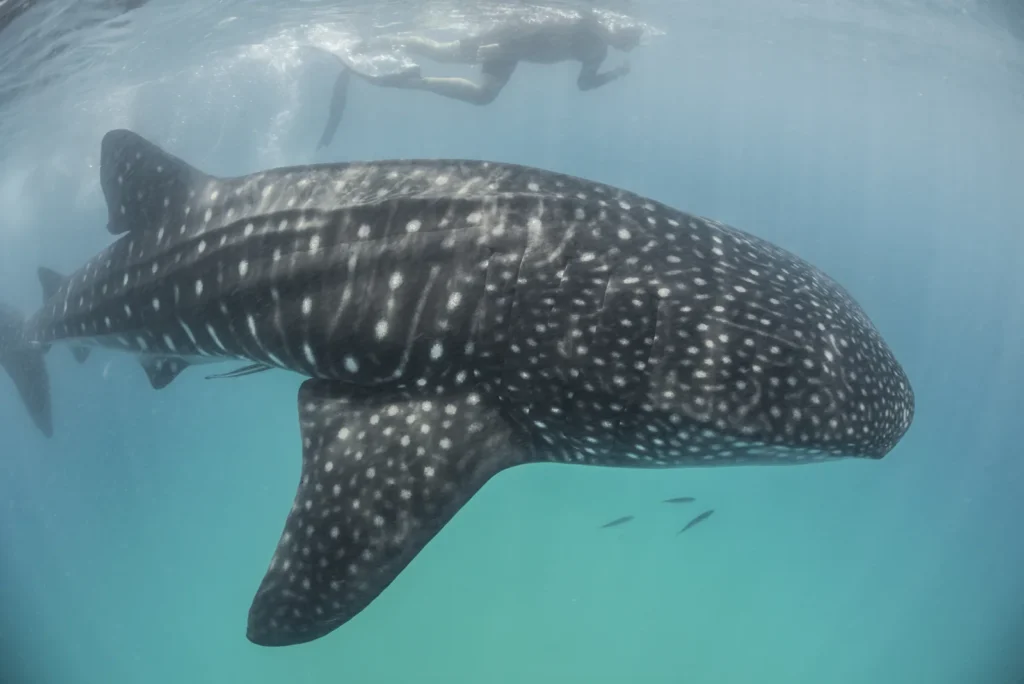
Whale sharks can have skin around 10 cm thick. Their fins follow a familiar shark outline, with paired pectoral fins, a prominent dorsal fin, and a long, powerful tail. Like other sharks, they are vertebrates with skeletons made of cartilage rather than bone. That flexibility helps them move with ease despite their size and weight.
Lifespan and young
A 2020 radiocarbon study validated ages up to 50 years. Whale sharks are long-lived, but their maximum lifespan remains uncertain. They also mature slowly, with different estimates of maturity for males and females.
They give birth to live young that develop from eggs retained inside the mother. A female caught off Taiwan in 1995 carried about 300 embryos at different stages of development. That observation is remarkable, but much of their reproductive biology remains poorly understood.
Encounters and protection
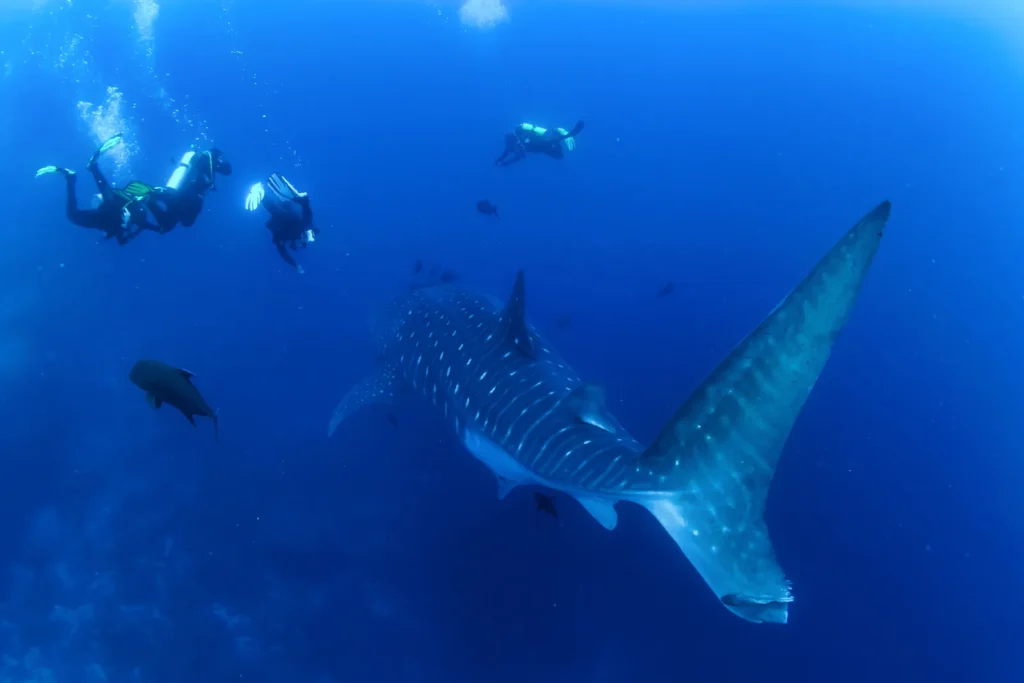
Seeing whale sharks can be memorable for divers. A filter feeder swimming near people is still a wild animal, so an encounter is a time to observe. Follow local rules and give it room:
- Never touch, chase, or feed it.
- Do not block its path.
- Stay clear of its powerful tail.
Only specialized aquariums can meet the species’ space and feeding needs. In the wild, fishing and vessel strikes remain threats. Whale sharks are listed as Endangered, as recorded in FishBase’s species profile.
The Philippines banned commercial fishing, sale, import, and export of the species in 1998. India introduced protection in 2001, and Taiwan later restricted catches.
For help noticing identifying details in other animals, read our marine life identification guide. That patient attention also draws me to photography; my ocean canvas photographs reflect the sea’s quieter side.