
Description
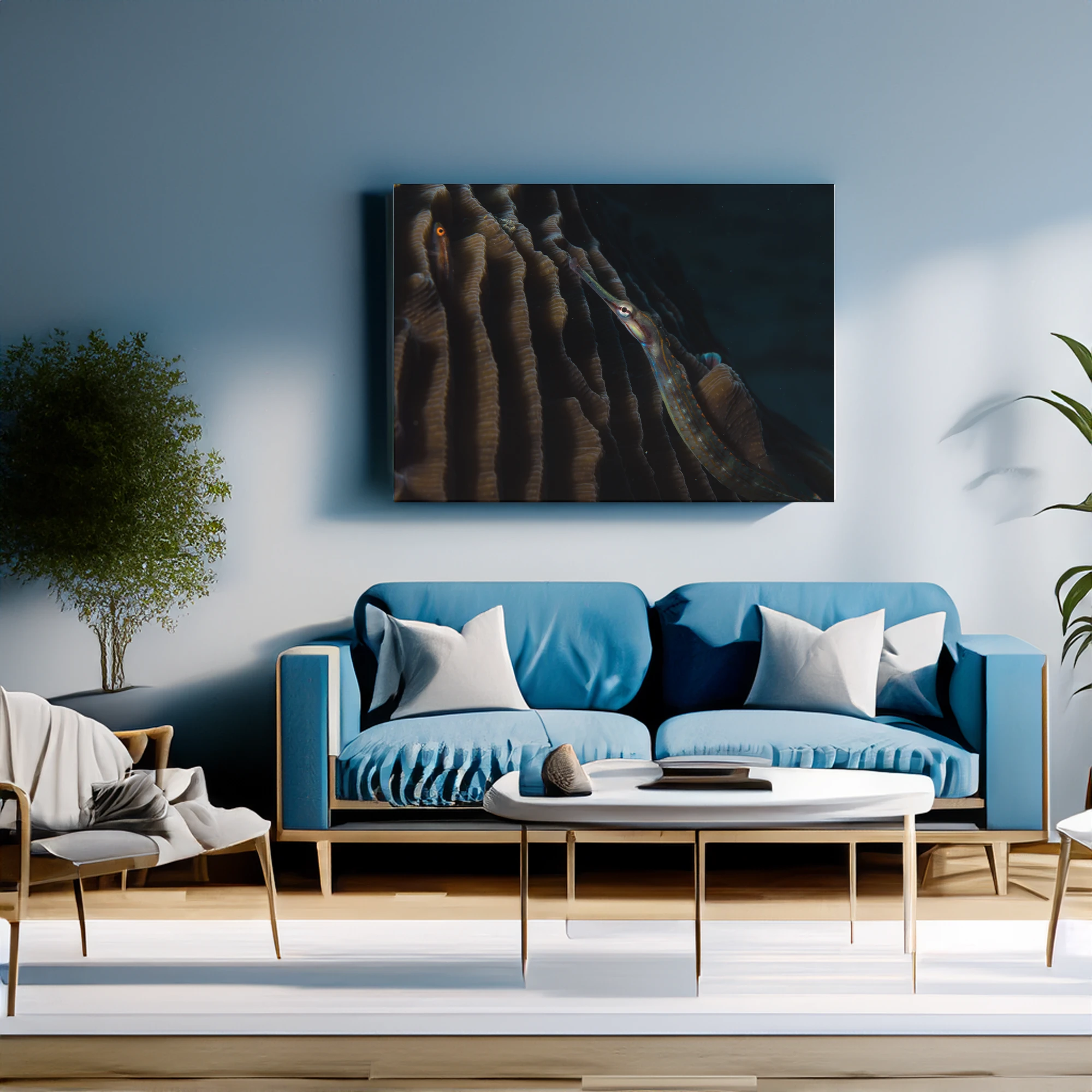
This Schultz’s pipefish canvas brings a slender reef fish into view beside the curved ridges of brain coral. Dim light gives the scene a quiet, concentrated quality, suited to a wall you can approach and study. Cobi Hay Yacobi photographed it in the Red Sea.
On this page
The pipefish photograph
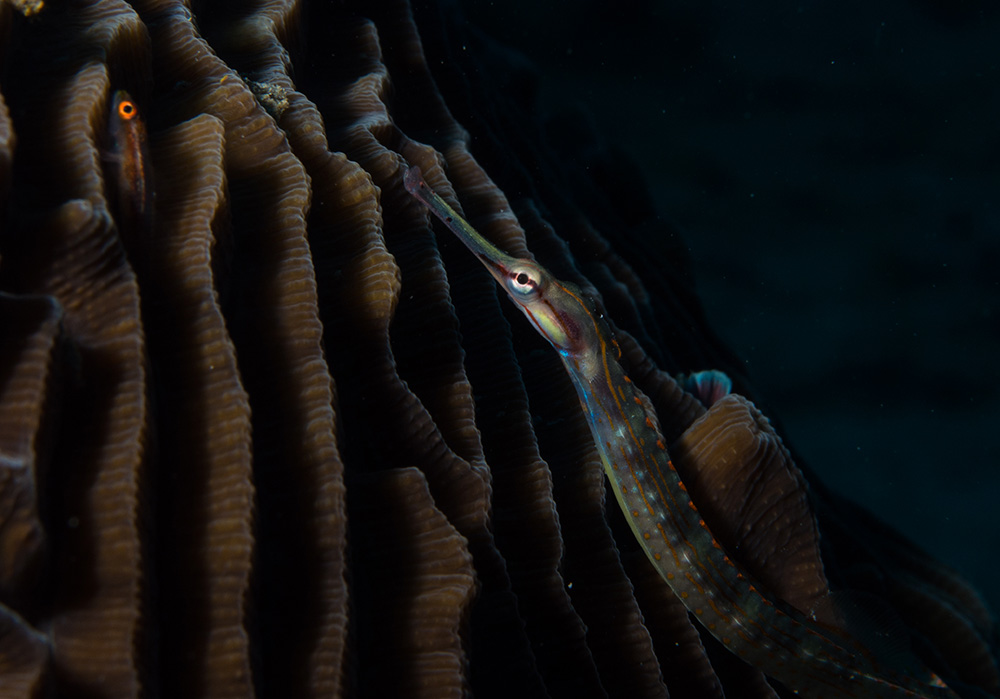
The pipefish canvas shows the head pointing diagonally upward and left. A pale eye stands out near the base of the long snout, while orange markings run along the narrow body. Brown coral ridges fill much of the left side. Dark space on the right separates the upper part of the fish from the background.
The photograph rewards a close viewing position. You can trace the fish from its head toward the lower edge, then follow the repeated folds of the coral beside it. At a greater distance, the diagonal body and curved ridges become the main structure. Both views are part of choosing a suitable place for the print.
The pipefish’s narrow shape makes looking an active part of the experience. You trace the animal rather than taking it in as a single broad silhouette. Beside it, the coral offers a second kind of line to follow. If you enjoy photographs that reveal their structure gradually, this relationship is a good reason to choose the image.
Meet the pipefish
Schultz’s pipefish, Corythoichthys schultzi, has a long head and a narrow, elongated snout. Its markings include stripes and spots around the snout, with bands along the body. The species occurs widely in the tropical Indo-Pacific, from the Red Sea and East Africa to Pacific islands.
The Fishes of Australia account of Schultz’s pipefish describes its identifying features and distribution. It also explains the name: the species honors Leonard P. Schultz, a former curator of fishes at the United States National Museum of Natural History. Looking at the snout and body pattern gives you a starting point for recognizing this fish.
Pipefish are relatives of seahorses. In this species, the male carries fertilized eggs in a pouch beneath his tail and releases the young after they hatch. Its partly transparent, striped body helps it blend among reef details. Those biological features add context to the photograph, even though egg carrying is not shown here.
Your Schultz’s pipefish canvas at home
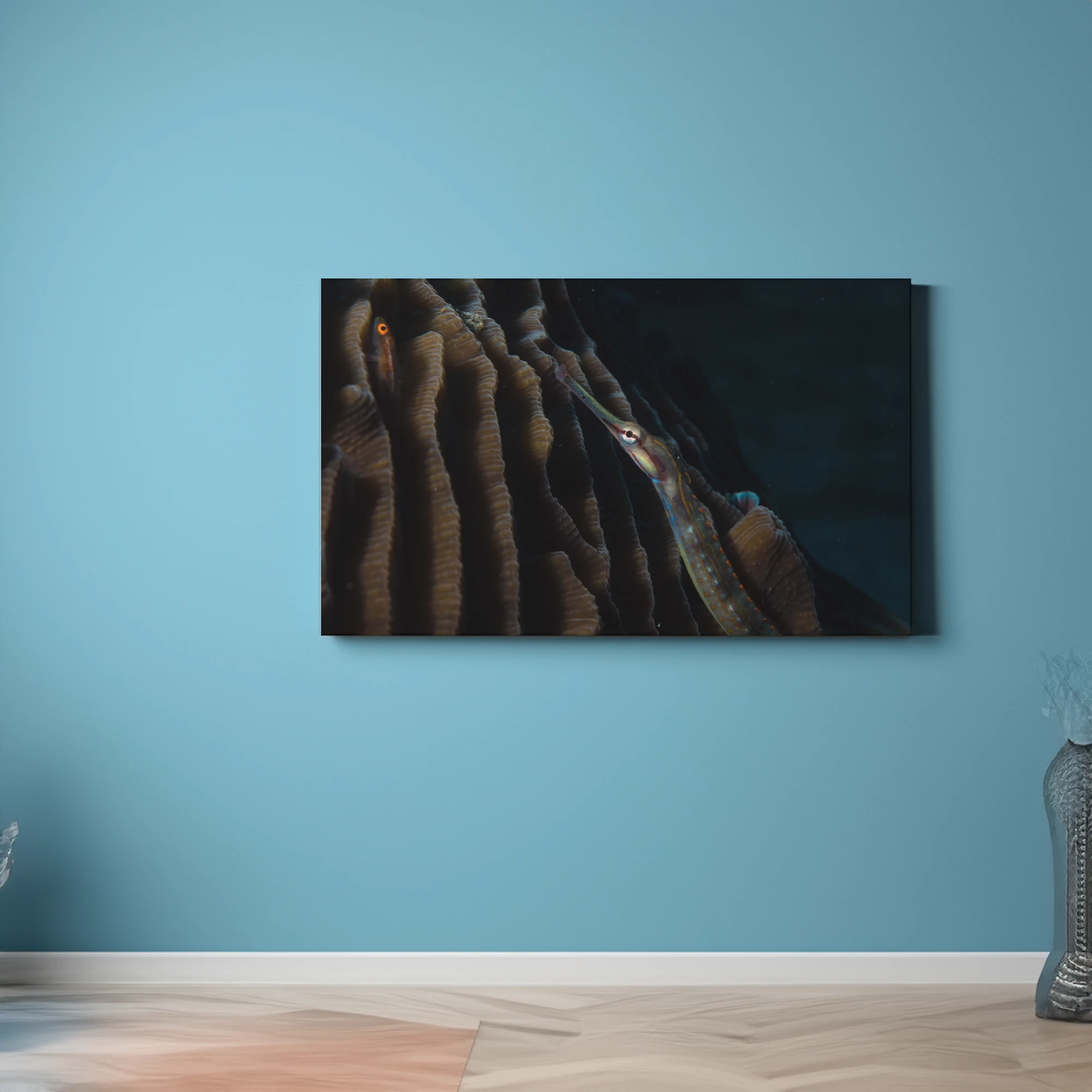
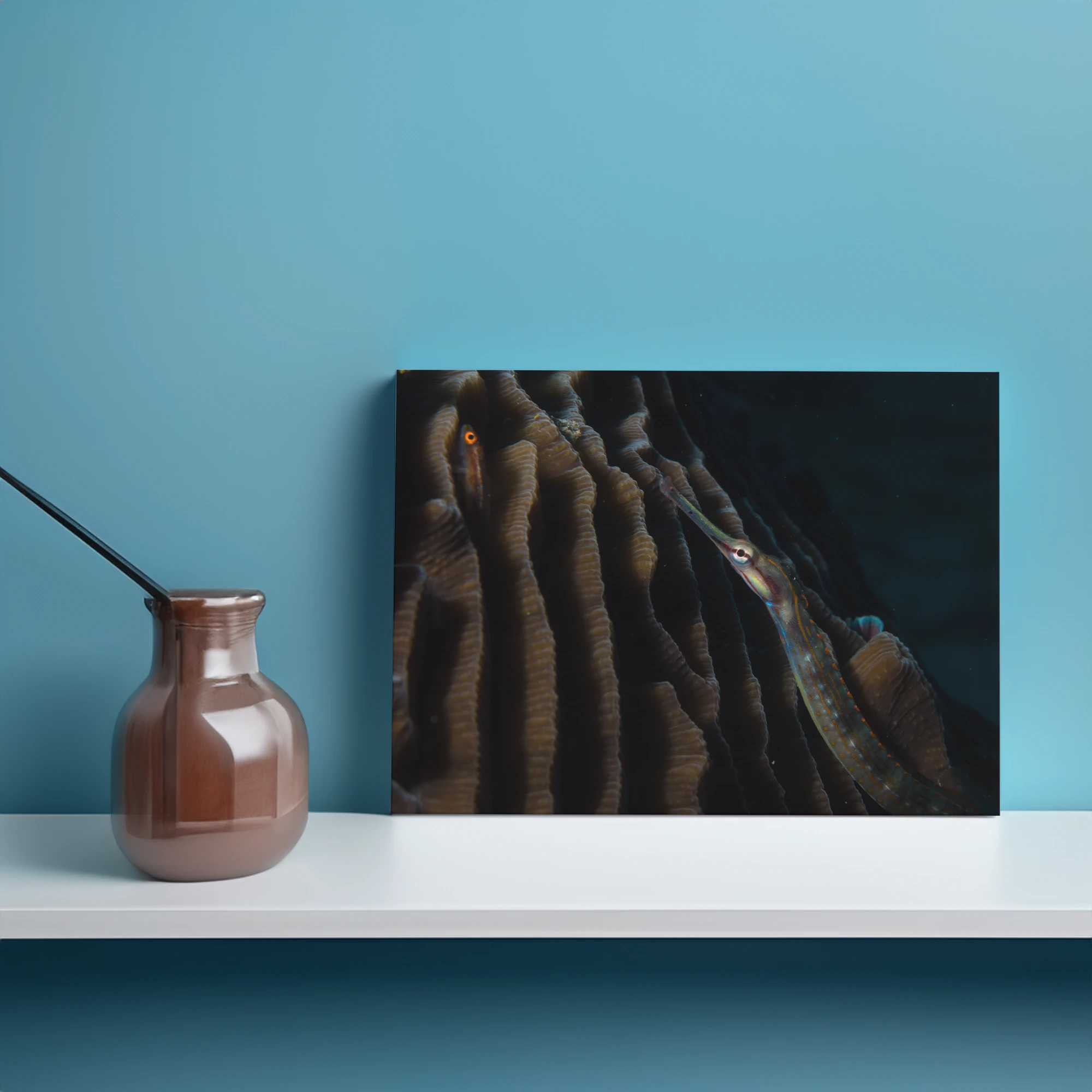
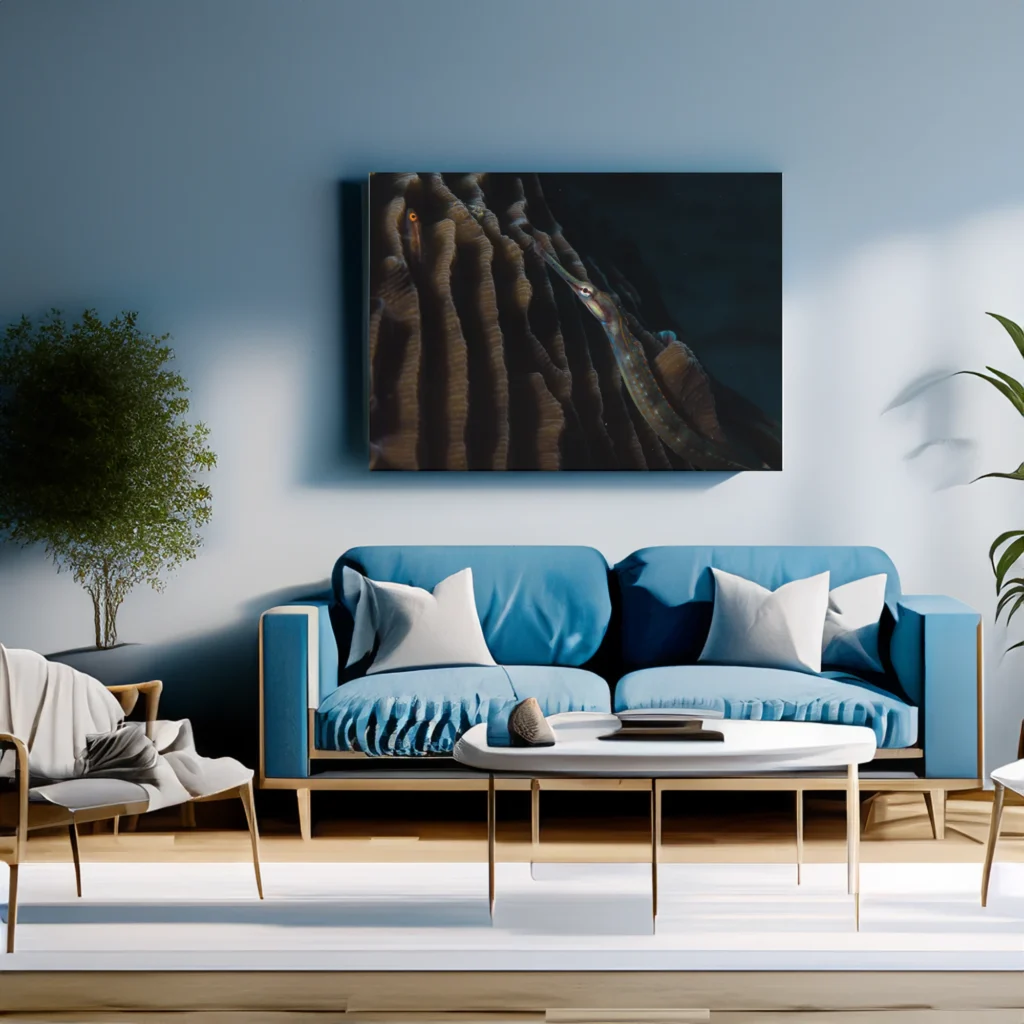
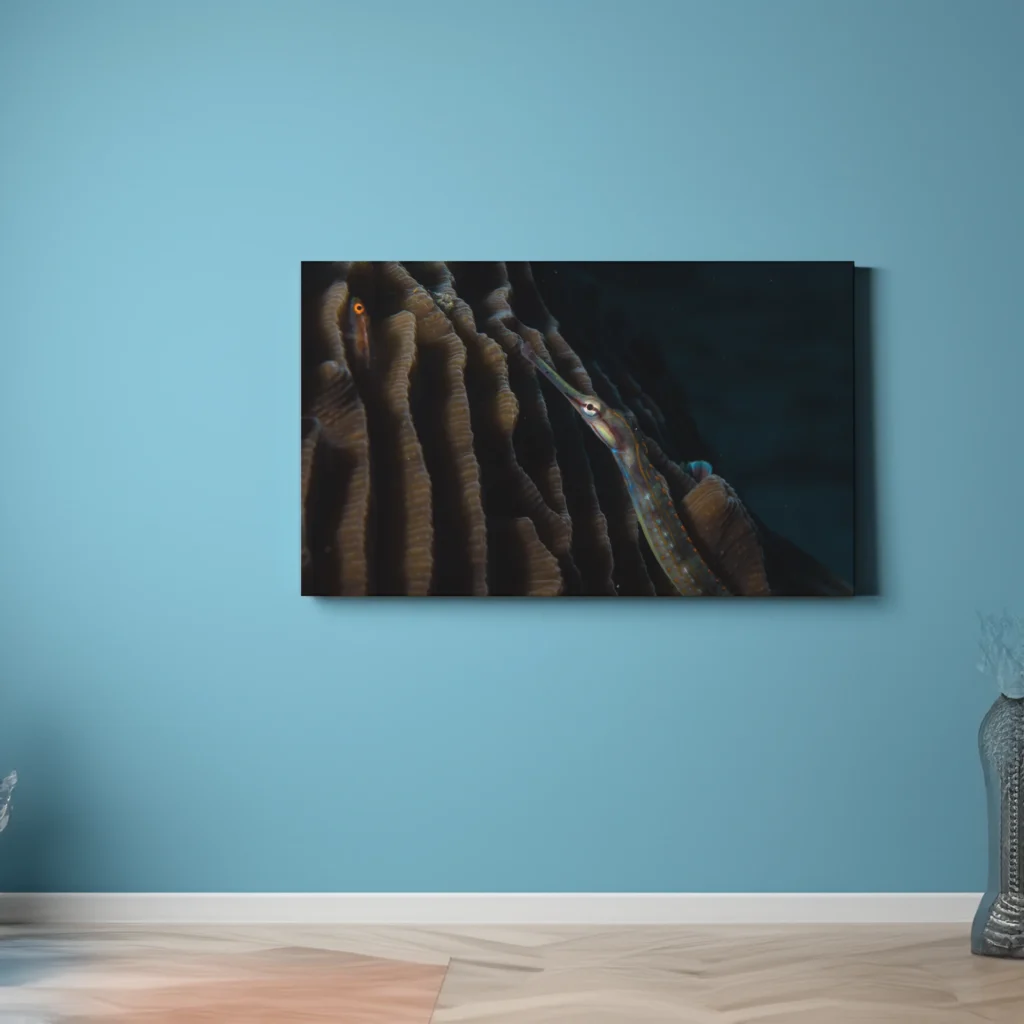
The display images show the pipefish in a blue-toned living room, hanging on a wall and, in the smallest version, resting on a shelf. Those arrangements offer two different viewing distances. A shelf can put the fine details close to everyday objects; a larger wall display lets the diagonal become part of the room’s overall composition.
Warm wood can relate to the coral’s brown tones without copying the whole palette. Keep the objects immediately beside the picture simple, especially on a shelf where books and ornaments can compete with the narrow fish. Check the depth of the surface and the height below any shelf above it.
For a desk area, choose a place you can stand beside for a closer look. A pipefish canvas rewards that access. If it joins other photographs, allow a clear gap so the fine lines do not merge visually with a neighboring image.
When comparing the pipefish with your other artwork, look for differences in line as well as color. A broad silhouette beside this narrow form can give each picture a clearer role in the arrangement.
Choose the size for your wall
- 12 × 8 in (30 × 20 cm) : $69 USD
- 30 × 20 in (76 × 51 cm) : $149 USD
- 36 × 24 in (91 × 61 cm) : $169 USD
All prices are in US dollars. Dimensions may vary by about 3 mm (1/8 in), and the image crop may change slightly between sizes while keeping the subject central. Check the selected option before adding it to your basket.
Use paper to mark the full width and height on your wall, then step back to your usual viewing position. Compare the outline with the furniture below and leave space around nearby lamps or shelves. For a group of photographs, include the gaps between them in your measurement. A room image helps you picture a setting; your own measurements determine which size fits.
Canvas finish and wooden frame
The matte surface of your Schultz’s pipefish canvas gives the photograph a textured surface you can see as you move closer. The image continues around the edges, so the picture has a finished side view as well as a front. Inside, a sustainably sourced pine frame supports the canvas at a depth of 0.75 in (1.9 cm).
The canvas is already stretched, hanging hardware is included, and it arrives ready to hang. A decorative outer frame is not included. You can leave the wrapped edges exposed or add a separate outer frame to coordinate with existing artwork. Allow for that frame’s extra width and height when planning a display.
Explore related photographs
The ornate ghost pipefish canvas offers another elongated marine form with a very different outline. Compare it with the blue-spotted toby canvas when deciding between a pair of slender subjects and a contrast in body shape.
Both are part of the fish canvas prints collection. For more about how colors are handled beneath the surface, read our underwater white balance guide. Let the pipefish photograph lead the choice if the relationship between animal and coral is what holds your attention, rather than trying to match a room by color alone.
About Cobi Hay Yacobi
Cobi Hay Yacobi is a marine nature photographer whose work centers on underwater life. His experience includes over 20 years of diving and more than 1,000 dives in the Red Sea and around the world. He selects photographs from thousands of images, using underwater cameras, dedicated lighting and patient observation.
The named animal and the place behind this photograph give you a starting point for exploring the work beyond its colors. Read Cobi’s photography background for more about the person behind the camera.
Printing and delivery
Your Schultz’s pipefish canvas is printed to order in the USA with non-toxic latex inks. Printing takes about 3 business days. After printing, estimated delivery is 2-5 business days to the USA or 10-30 business days to Canada, Australia and other eligible countries. Allow for both stages when planning an occasion; express shipping is not available.
Shipping is free to the USA, Canada and Australia. For other eligible countries, the first canvas costs US$25-US$36 to ship, depending on size, plus US$8 for each additional canvas. The total appears at checkout before payment. Outside the USA, import duties or taxes may apply. The English shop does not ship to the EU, the EEA or the UK.
For a gift going directly to someone else, enter the recipient’s delivery address at checkout. You receive an order confirmation by email after payment and a tracking number by email when the canvas ships.
Frequently asked questions
How should I care for the Schultz’s pipefish canvas?
Choose a dry, ventilated room away from direct sunlight and high humidity. Clean the surface only with a soft, dry cloth. Make these conditions part of choosing the display position, especially near a window.
Can I ask about a different size?
Yes. Use our canvas size and framing support to discuss an option outside the listed range before ordering. Include the wall dimensions and the name of this photograph so we can understand the space you have in mind.
Where can I read the return and cancellation terms?
See the Returns & Refunds policy for the terms that apply to your order. Review the selected size, quantity and delivery details before completing payment.
How do I place my order?
To order your Schultz’s pipefish canvas, select an available size and quantity, then add the canvas to your basket. At checkout, provide your name, email, delivery address and phone number. Review the total and correct any errors. Available payment methods are shown there and processed by an authorized payment provider. The contract is formed after payment, when your order is confirmed.

Reviews
There are no reviews yet.